
Discover Kuwait: A Blend of Modernity and Tradition
Key takeaways
• Kuwait’s identity is built on two foundations at once: a centuries-old pearling and maritime trade heritage, and one of the fastest-modernized skylines in the Gulf.
• Landmarks like Souk Al-Mubarakiya and Sadu House sit within walking distance of Kuwait Towers, Al Hamra Tower, and The Avenues — old and new occupy the same few square kilometres.
• Social traditions like the majlis and diwaniya have not disappeared with modernization; they’ve simply moved into new architectural forms.
• Kuwait’s next chapter, including the planned Madinat al-Harir (Silk City), is being designed to carry heritage motifs into entirely new construction.
Kuwait is a small country with an outsized architectural personality. Drive through Kuwait City and you’ll pass a nineteenth-century pearl merchant’s courtyard house within a few minutes of a glass tower shaped like a sail. Walk through Souk Al-Mubarakiya at midday and the smell of cardamom coffee and dates drifts between stalls that have traded in roughly the same spot for over a century — while, a few streets away, an air-conditioned mall stretches for a kilometre under a domed glass roof.
That contrast isn’t accidental, and it isn’t a contradiction either. It’s the clearest expression of what Kuwait actually is: a nation that modernized faster than almost anywhere else in the region, without fully setting aside the culture that came before oil.
A Nation Built on the Sea

Long before oil revenue transformed the Gulf, Kuwait’s economy and identity were built on the sea. Kuwaiti dhows sailed as far as East Africa and India for trade, and the pearling industry — hard, seasonal, dangerous work — shaped the rhythm of life for generations of families along the coast.
Traces of that maritime heritage are still visible today. The dhow harbour near Kuwait City continues to build and repair traditional wooden boats using techniques passed down through families of shipwrights. The Kuwait Maritime Museum and the old seafront gates, including remnants of the historic town wall, preserve the physical memory of a Kuwait that existed long before its skyline did.
This is the layer most visitors miss if they only see the towers: Kuwait’s modern wealth is recent, but Kuwaiti identity is not. The seafaring, trading, pearl-diving culture is the root the rest of the country grew from.
The Skyline That Redefined the Gulf
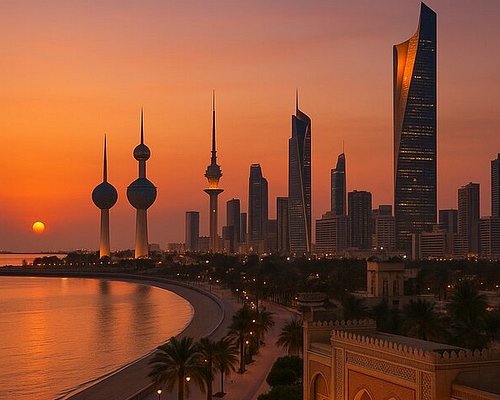
Kuwait was, in many ways, an early mover in Gulf modern architecture. The Kuwait Towers, completed in 1979, remain one of the most recognisable silhouettes in the region — a pair of blue-and-white spheres on slender concrete stems that still function as a working water tower and observation deck.
Liberation Tower, one of the tallest telecommunications towers in the world at the time of its completion, and the sculpted, dune-inspired form of Al Hamra Tower — long one of the tallest sculpted concrete towers globally — show a consistent pattern: Kuwaiti landmark architecture tends to be sculptural rather than purely functional, designed to be recognised as a symbol as much as used as a building.
That instinct continues today. The Avenues, one of the largest shopping and lifestyle developments in the Gulf, mixes contemporary retail architecture with themed districts referencing different design traditions. And on the horizon sits Madinat al-Harir, or Silk City — a long-term mega-development planned for northern Kuwait that, if built out as envisioned, would include one of the world’s tallest structures alongside new residential and business districts.
Where the Souk Meets the Skyscraper
The most Kuwaiti experience available to any visitor is the short walk between Souk Al-Mubarakiya and the modern city that surrounds it. The souk, one of the oldest markets in Kuwait, still operates as a genuine working market — spice merchants, textile stalls, gold shops, and small restaurants serving traditional dishes like machboos and mutabbaq samak sit under covered walkways that have hosted trade since before the modern state existed.
Step outside its gates and Kuwait’s contemporary skyline takes over almost immediately. Modern office towers, banks, and government buildings surround the historic core rather than replacing it. Unlike cities that pushed their old quarters to the periphery, Kuwait City kept its traditional market at the centre and built the modern city around it.
This proximity is not just convenient for tourists — it reflects something real about how Kuwaitis use the city. A single afternoon might include a coffee bought in the souk the same way it’s been sold for decades, followed by dinner at a design-forward restaurant in a glass tower two streets away.

A Living Culture: Majlis, Diwaniya, and Hospitality
Kuwait’s modernization changed buildings far more than it changed social customs. The diwaniya — a dedicated gathering space, traditionally a separate room or building attached to a family home — remains a central feature of Kuwaiti social life. Men and women host regular gatherings in these spaces for conversation, business, and community discussion, a tradition with roots stretching back generations.
What has changed is the architecture around the custom. Where a diwaniya was once a simple majlis room with floor seating and Arabic coffee served from a dallah, many contemporary Kuwaiti homes now design purpose-built diwaniya wings with modern furniture, media systems, and formal entrances — the function preserved, the form updated.
Hospitality itself follows the same pattern. Serving Arabic coffee (qahwa) and dates to a guest before any conversation begins is still close to universal in Kuwaiti households, whether that household is a century-old courtyard home in the historic quarter or a new-build villa in a suburb that didn’t exist twenty years ago.

Architecture as the Bridge Between Eras
Nowhere is Kuwait’s old-meets-new identity more literal than in its buildings. Traditional Kuwaiti and wider Gulf architecture relied on climate-responsive design: thick walls, shaded courtyards, and wind towers (barjeel) that captured breezes to cool interior spaces long before mechanical air conditioning existed. Wooden mashrabiya screens filtered sunlight and provided privacy while still allowing airflow.
Contemporary Kuwaiti architects and interior designers regularly reach back to these principles, not out of nostalgia but because they work. Geometric mashrabiya-style screens reappear on modern facades as sunshading. Courtyard logic reappears in the layout of contemporary villas and boutique hotels. Institutions like Sadu House, dedicated to preserving traditional Bedouin weaving, and the Kuwait National Museum sit alongside newer cultural venues that borrow the same decorative language in a distinctly modern register.
This is where Kuwait’s story becomes most relevant to anyone shaping the built environment here. The blend of modernity and tradition isn’t only a cultural talking point — it’s a design brief. Interiors and facades that reference heritage motifs, courtyard planning, and climate-conscious detailing don’t just look considered; they tend to perform better in Kuwait’s climate than imported design language borrowed wholesale from elsewhere. It’s a theme Atlas International keeps returning to in its own fit-out and construction work: a space in Kuwait reads as authentically Kuwaiti when it carries some trace of that history, even inside a fully contemporary shell.
Bringing It All Together
Kuwait rewards visitors and residents who look past the skyline for its own sake. The towers are genuinely impressive, but the story they tell only makes sense next to the souk, the diwaniya, and the dhow harbour they grew up around. Modernity and tradition here aren’t opposing forces — they’re two chapters of the same national story, built a few streets apart from each other.
For anyone designing, building, or fitting out a space in Kuwait, that same blend is worth designing toward deliberately, rather than defaulting to one register or the other.
Frequently Asked Questions
What makes Kuwait’s culture a blend of modernity and tradition?
Kuwait combines a centuries-old pearling, trading, and Bedouin heritage with one of the earliest and boldest modern skylines in the Gulf, and it has kept historic sites like Souk Al-Mubarakiya at the centre of the modern city rather than pushing them to the outskirts.
What are the must-see landmarks that show Kuwait’s mix of old and new?
Souk Al-Mubarakiya and Sadu House represent Kuwait’s traditional side, while Kuwait Towers, Al Hamra Tower, Liberation Tower, and The Avenues represent its modern skyline — all within a short drive of each other in and around Kuwait City.
Is the diwaniya tradition still practised in modern Kuwait?
Yes. The diwaniya remains a central part of Kuwaiti social life, and many contemporary homes now include purpose-built diwaniya spaces designed with modern architecture and furnishings while keeping the traditional gathering function intact.
How does traditional Kuwaiti architecture influence modern buildings?
Climate-responsive elements from traditional Gulf architecture, such as wind towers (barjeel) and mashrabiya screens, continue to influence contemporary Kuwaiti design because they manage heat and light effectively, and modern architects often reinterpret them in facades and interiors rather than discarding them.